
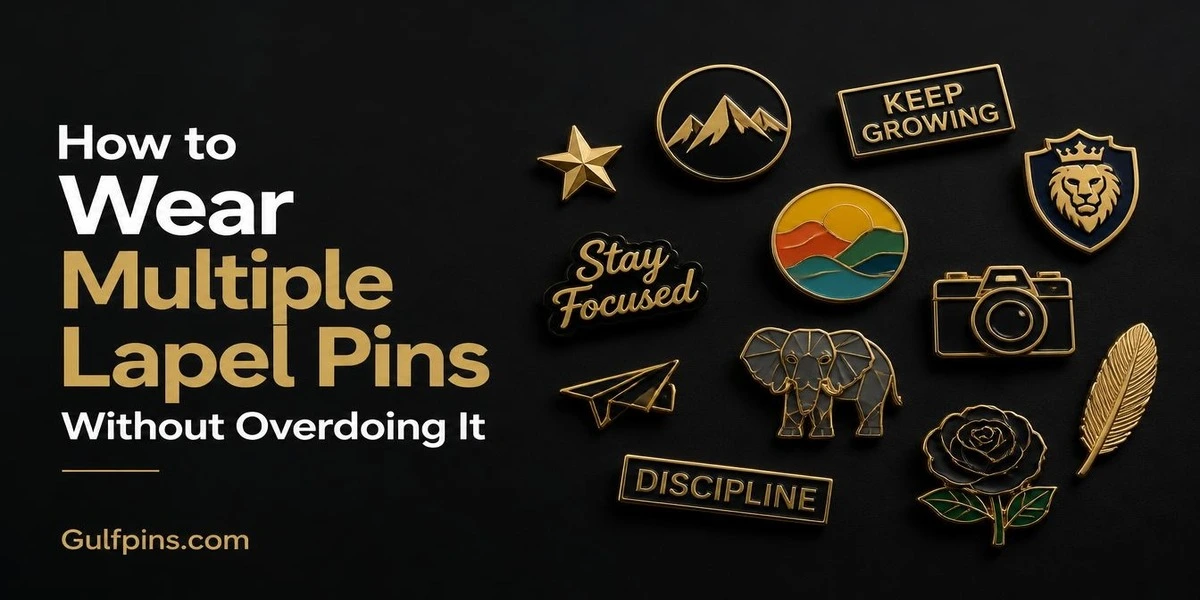
How to Wear Multiple Lapel Pins Without Overdoing It
A single lapel pin takes no planning. You fix it near the buttonhole on the left lapel and carry on with your day. Add a second or a third and the jacket starts to look different. Two pins can look deliberate, but the same two placed apart with nothing linking them can look like leftovers from a conference bag.
One rule separates the two outcomes: every pin should have a reason to be there. That reason might be a company, an event or something personal, as long as it is clear to anyone who glances at it. This guide explains how to wear lapel pins together so they look planned, and when a jacket already has enough.
What Are Lapel Pins and Where Do People Wear Them?
A lapel pin is a small pin worn on the lapel of a jacket, usually on the left side near the buttonhole. Most are made of metal, enamel or a mix of both. Each one usually stands for something, like a company, an event, a membership or an award, though some people wear one just because they like how it looks.
You will see them in a few familiar places:
- At work: staff wear a company pin, often as part of a uniform or a client-facing dress code.
- At conferences and events: speakers, hosts and guests wear one that links them to the event.
- At ceremonies: graduations, award nights and weddings, where a pin adds a small finishing detail.
- Day to day: on a blazer or coat, as a personal touch.
Suits and blazers carry pins best because the lapel gives them a firm, flat place to sit. A coat or denim jacket can carry one too, with more room for casual styles.
One pin is easy to place. Several change how the whole lapel looks so that is where the choices start to matter.
Fewer Pins Usually Look Better
There is no fixed number that suits every jacket, but fewer pins almost always look cleaner. What changes the answer is the occasion.
| Occasion | What usually works |
| Formal event | One pin |
| Business meeting or office | One or two |
| Ceremony or conference | Two or three, if they relate to each other |
| Casual jacket | More, as long as they share a theme |
Odd numbers tend to look more natural. Three small pins in a loose triangle often look more relaxed than a pair sitting side by side. That is a habit of the eye, not a rule, so go with whatever looks right on your jacket.
A quick test helps. Put the jacket on, look in the mirror and notice your first thought. If it is “that’s a lot”, take one off. Nobody looks at a lapel and wishes it had one more pin.
If you own a bigger collection, a tailored suit is not the best place for it. A denim jacket, a vest or a bag can carry many pins without looking crowded.
Once you know how many to wear, the next question is where they go.
Where Should Lapel Pins Go on a Suit?
Knowing how to wear lapel pins starts with knowing where they sit. The left lapel, just above or beside the buttonhole, is where most people put theirs. It is the spot people expect, and it keeps a group of pins looking planned. The right side is fine for a deliberate choice, like balancing a pocket square, but it is easier to get wrong.
With more than one pin, keep them together as one small group. Pins spread across the lapel look like separate decisions and the jacket starts to feel busy. You should avoid two things. Do not place them too low where they start to look like a name badge. They cannot be too close to the edge where they tilt or catch on the fabric.
Where the pins go also depends on what you are wearing:
| Garment | Where it works |
| Suit | Left lapel, near the buttonhole |
| Blazer | Upper left lapel |
| Coat | Upper lapel or chest, where thicker fabric holds the weight |
| Shirt | Collar or pocket, with a very light pin only |
| Denim jacket | Pocket or upper panel |
Once the pins are in the right place, the next job is arranging them so they sit well together.
How to Arrange Multiple Lapel Pins, Step by Step
The easiest way to wear lapel pins in a group is to build the arrangement one pin at a time. Lay them out on a table first if you can. It is much easier to fix a bad pairing before anything goes through the fabric.
- Choose the lead pin. This is the one you most want people to notice, usually the larger or more meaningful piece. It goes in the main spot, near the buttonhole on the left lapel.
- Add one smaller pin. Pick something that shares a metal, a color or a theme with the first, so the two look like they came from the same set.
- Place them close without touching each other. Leave a small gap. It should be enough that each pin keeps its outline. If the pins overlap, the details of both get lost.
- Choose a simple shape. Two pins can sit in a short line. Three can form a small triangle or a vertical row. Keep the gaps even and the group compact.
- Add a third pin only if it earns its place. Leave it off if it makes the group feel heavier rather than more interesting.
- Check it in the mirror. Stand back and look at the whole jacket. Each pin should sit flat. Nothing should tilt and no pin should pull the fabric down.
If the group looks busy at this point, take the smallest pin off and look again. It usually fixes the problem.
Once the arrangement is set, the next question is whether the pins look like they belong together in color and size.
Matching Pins by Metal, Color and Size
Pins look like a set when they repeat something. Metal, color and size are the three things the eye checks first.
Metal
- Two gold pins, or two silver ones, sit together without effort.
- One gold and one silver pin usually looks like an accident.
- A watch or belt buckle in the same metal adds a small detail people notice without knowing why.
Color
- A pin with navy enamel details looks planned on a navy suit.
- A second pin that picks up the same shade ties the group together.
- The colors do not need to match exactly, only to look related.
Size and texture
- Pins of the same size compete, so a clear difference works better, such as one medium pin with a smaller one beside it.
- Polished metal and matte enamel can share a lapel.
- If everything is shiny and detailed at once, even two pins can feel crowded.
The rest of the outfit
A bold tie or a patterned pocket square already draws the eye. When the outfit is busy, smaller and plainer pins let the whole look breathe.
If a group still feels off, these are the things to check, in this order:
- Do the metals match?
- Do the colors look related?
- Is one pin clearly bigger than the others?
Matching is only half of it, because a good-looking group still has to hold up on the fabric.
A Good Pin Looks Crisp Up Close
A pin earns its place on a lapel when it still looks sharp from a handshake away. You can tell a lot about how well it is made from a few small details.
Clean edges
Edges should be smooth, with no rough spots or visible glue. Rough edges are the first sign of a rushed pin.
Even color
Enamel should fill each section evenly, without gaps or color spilling into the next area. Small lettering and fine lines should stay readable, because that is where a poorly made pin gives itself away.
A firm clasp
A solid backing holds the pin upright all day. A loose one lets it droop or fall off without you noticing.
A smooth finish
Run a finger over the surface. It should feel smooth and hold up to a rub without flaking.
Why they should be in a group
Quality shows more when pins are worn together. A well-made small pin stays crisp next to a bigger one while a weak one looks worse beside it.
Why companies order custom pins
Many companies order custom lapel pins instead of buying off the shelf. A set for staff, a pin for an event, or a main logo pin with a smaller accent to wear beside it all fit the group styling covered above.
Buyers also tend to compare options beyond one city so searches like “lapel pins near me UAE” often sit next to local ones. What matters more than distance is whether the pins in front of you look good on a real lapel.
Heavy Pins Can Damage Thin Fabric
A few light pins on a sturdy jacket are rarely a problem. The trouble starts when the weight and the fabric do not match, and it is easy to avoid once you know what to look for.
What goes wrong
- Heavy pins pull on thin fabric, and the lapel starts to sag.
- Every pin leaves a small hole, and delicate cloth shows it more.
- A narrow lapel has little room, so a group of pins crowds it and tilts.
What helps
- Choose lighter pins for lighter jackets, and save heavier ones for thick wool or a coat.
- Look at the backing. A locking or anti-rotation clasp keeps a pin upright instead of letting it spin and lean.
- Count the pins against the lapel. A wide lapel can carry a group, and a narrow one usually looks better with fewer.
When it feels too heavy
If the jacket looks pulled down on one side, move a pin somewhere else, such as a bag strap or a pocket. A flat, secure pin looks better than a heavy one dragging the cloth out of shape.
Weight is one reason to look closely at how a pin is made, and build quality is the next thing worth knowing.
What to Check Before Ordering Custom Pins
A few questions up front save a lot of back and forth later, whether you are choosing a metal pins supplier in Qatar or comparing a few options side by side.
The pin itself
- Finish and size: ask which options are available, and whether a smaller accent pin can be made to go with a main logo pin.
- Clasp type: check the standard backing and whether a locking one is offered.
- Color matching: if your logo uses a specific brand color, ask how it will be matched in the enamel.
The order
- Artwork: find out which file formats the supplier needs and whether they help prepare the design.
- Sample or proof: ask to see one before the full run, so you can check the detail, the color and how it sits on a real lapel.
- Minimum order and timing: confirm the smallest quantity and how long production and delivery usually take, especially if an event date is fixed.
Once these answers are clear, you can compare suppliers on the same terms and choose with confidence.
Signs You Have Overdone It
Most lapels go wrong in small ways, and a quick look in the mirror shows them. Step back and check the group against these signs.
Nothing stands out
If every pin is the same size and weight, the eye has nowhere to land. One should clearly lead.
The metals clash
A gold pin beside a silver one, with nothing linking them, looks like a mistake.
The pins touch
Crowded pins lose their fine details. A small gap lets each one keep its shape.
The jacket pulls to one side
Pins with excessive weight for the cloth and cause the lapel to sag or ripple. Take one off or move it to a bag.
You keep adjusting them
If you notice the pins every few minutes, there are probably too many. A good arrangement is one you forget about. When more than one of these shows up, take off the smallest pin and look again. Two pins that belong together will always look better than four that do not.
All Your Queries Answered About Wearing Lapel Pins
What is the difference between a lapel pin and a brooch?
A lapel pin is usually small and flat, made to sit quietly on a jacket and often stands for a company, event or membership. A brooch is generally larger and more decorative, and it is worn as a statement piece on jackets, coats or dresses.
What types of lapel pin backs are there?
The most common are the butterfly clutch, the rubber clutch and the locking clasp. A locking clasp holds the pin most firmly. Magnetic backs leave no hole in the fabric, but they suit lighter pins better than heavy ones.
How do I fasten a lapel pin so it stays in place?
Push the post through the top layer of the lapel, then secure the backing at the back. Check that the pin lies flat and does not tilt. A loose backing is the usual reason a pin droops or goes missing during the day.
Can women wear lapel pins the same way?
The same ideas apply here. Keep the group small, match the metals and let the fabric carry the weight. Many women pin on the left lapel too, though it is a matter of preference and some choose the side that suits the jacket.
How should I clean and store lapel pins?
Wipe them with a soft, dry cloth and avoid soaking enamel pins. Store them separately in a lined box or on a foam board, so they do not scratch each other. Fasten the backing back on after wearing, so it does not get lost.
Wear Them Like They Belong
A good lapel rarely needs more than two or three pins that sit well together. Once the pins share a look and the jacket still hangs the way it should, there is not much left to fix.
If you are unsure, start with two and wear them for a day. You will notice quickly whether the group feels right or whether something should come off. The pin you leave off often does as much for the look as the ones you wear.

Rashaa el Ebrahim is a passionate content contributor at GulfPins.com, sharing insights about custom pins, enamel badges, branding solutions, and promotional products. With a focus on helping businesses across the Gulf make informed decisions, Rashaa creates practical guides, design tips, and industry-focused content that helps brands choose the right custom pin solutions to strengthen their identity and connect with their audience.