
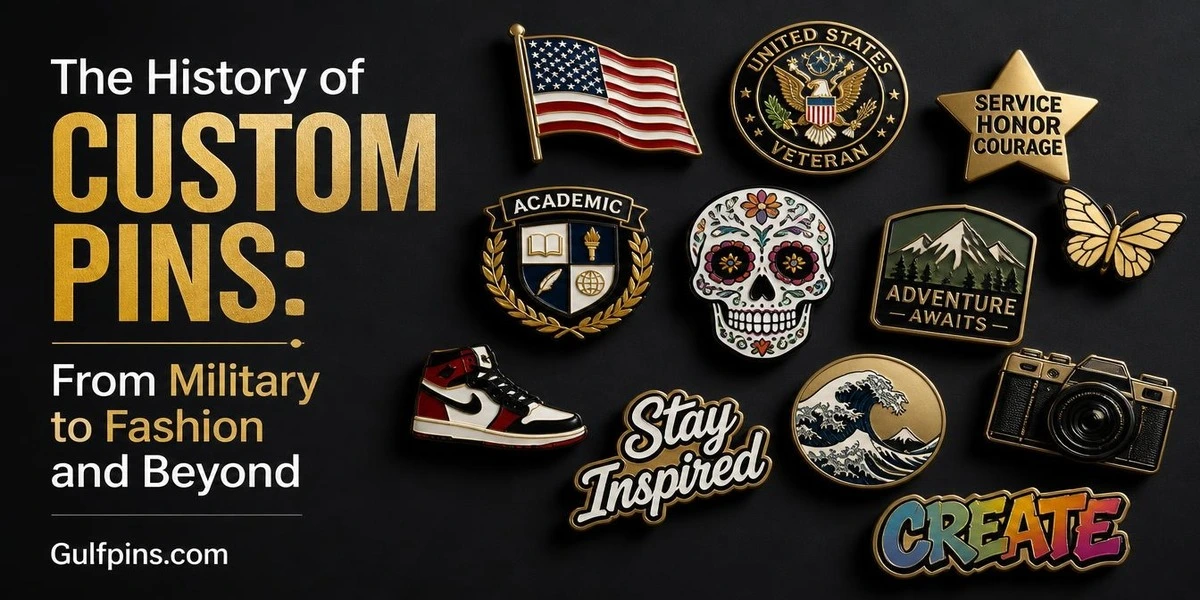
The History of Custom Pins: From Military to Fashion and Beyond
Soldiers in the American Civil War wore a small brass pin with their unit number on it. It was a plain way to tell one unit from another, and nobody thought of it as an accessory. When the war ended, many of them kept the pins and wore them in memory of friends who did not come home.
Today the same kind of small metal badge sits on a staff uniform, a denim jacket or a school bag. The reason has not changed much. People still use a pin to show where they belong. This blog follows that change from the battlefield to the fashion rack.
What is a Custom Pin?
We are here to cover everything you need to know about custom pins. First we will talk about what they actually are. A custom pin is a small metal badge made from your own design. It can carry a logo, a symbol or a name, and it fastens to a lapel, collar, hat or bag with a pin or clutch on the back. Since the design is yours, no two orders need to look alike.
Most custom pins come in one of three finishes, and the finish changes how a pin looks and feels:
- Soft enamel: the color sits slightly below raised metal lines, so you can feel the texture.
- Hard enamel: the surface is smooth and polished. It is more durable and usually costs more.
- Die-struck: plain metal with no color, just the stamped design.
Pins like these have been worn for very different reasons over time, and the history is where it gets interesting.
Where Did Pins Come From?
The craft behind a pin is older than the pin itself. Enameling is the art of fusing colored glass onto metal. Early cloisonné, which uses thin metal walls to hold each color in place, was used for jewelry in Egypt and China somewhere between 1500 and 500 BCE. Historians still disagree about where it started, and the earliest place and date have never been pinned down.
So the safest way to put it is this:
- The enamel craft is ancient.
- Nobody can say exactly where it began.
- The pin as a badge that shows who you are came much later.
That later part is where the story gets more personal, and it starts with soldiers.
Military Pins Represent Rank, Unit and Honour
At first, military pins were purely practical. During the American Civil War, soldiers wore small brass pins showing a unit number so that men from different units could be told apart. When the war ended, many of them kept the pins and wore them in memory of friends who did not come home. A marker of unit became a marker of loyalty.
The meaning kept shifting from there, as the table shows.
| Period | What the pin did |
| Civil War | Showed which unit a soldier belonged to |
| After the war | Kept as a memento of fallen comrades |
| World War I | Marked service and loss, including pins worn by families at home |
| Today | Shows rank, branch, training and awards |
That last row is how most armed forces use pins now. Some show where a person serves. Others show what they have trained for or earned. A few are given only for exceptional service, so a single pin on a uniform can say a lot in very little space.
Civilians noticed. A badge that began as a tool for armies became a way for anyone to show loyalty to a group, a country or a cause. That is the next part of the story.
Pins in Politics and Social Movements
Pins moved into public life soon after they left the battlefield. Politics was the first place they took hold, and three kinds of pins show how.
Flag Pins
Nobody can say exactly when the flag lapel pin began. What we do know is that Americans only started treating the flag as a personal symbol of loyalty around the Civil War, and the pin grew out of that habit. Politicians still wear it as a quick way to show patriotism.
Campaign Buttons
Campaign buttons are a close cousin of lapel pins, but they are not the same thing. The 1896 race between William McKinley and William Jennings Bryan brought the first mass-produced buttons that people collected.A company called Whitehead & Hoag had just patented a pin-back button covered in a thin layer of celluloid, which protected the printed picture. Supporters could now wear a candidate’s face on a coat.
Cause Pins
Later, people began wearing pins for causes as well as candidates. They work well for a few reasons:
- A rainbow pin or an awareness ribbon says “I support this” without a word.
- They are small and cheap to make, so a group can hand them out to a whole crowd.
Once a pin could carry a message this easily, designers and everyday wearers soon made it part of their style.
How Pins Became Fashion
For a long time, pins belonged to uniforms, clubs and political campaigns. Wearing one meant you were part of a group. Fashion changed that by making the pin about the wearer.
The Instagram Effect
Enamel pins began growing in popularity around 2015, after they found a new audience on Instagram and other social platforms. A pin photographs well. A jacket covered in them tells people who you are before you say a word.
Popular Among Small Makers and Streetwear
Etsy and Instagram gave independent artists a cheap way to sell their designs. They do not need to own a shop. Streetwear brands noticed and started releasing pins in limited drops. It pushed collectors to trade and hunt for them. Custom pins gave everyone a simple way to turn their own artwork into something people could wear.
Where They Show Up Now
- Jackets, hats and denim
- Backpacks and tote bags
- Display boards and cases for collections
Once pins became popular enough to sell, it was only a matter of time before businesses wanted their own.
Custom Pins for Business and Branding
A pin with a logo on it is a simple way for a business to be seen. Companies and groups use custom pins in a few common ways:
- Staff pins for hotels, restaurants and offices
- Event pins for conferences and exhibitions
- School and club badges for members
- Service awards for years of work
Choosing a Finish
The finish decides how a pin looks, how long it lasts and what it costs, so it is the first choice to make.
| Finish | What to expect |
| Soft enamel | Raised metal lines, a textured feel and a wide range of colors. Usually the cheaper option |
| Hard enamel | A smooth, polished surface. More durable and usually costs more |
| Die-struck | Plain metal with no color, just the stamped design |
How an Order Usually Works
- Choose the type of pin.
- Send your artwork.
- Approve the proof.
- Check a sample.
- Go ahead with the full order.
Exact steps can differ from one supplier to another.
Buying in Bulk
If you plan to order wholesale lapel pins Egypt, ask the supplier three things before you commit anything like the minimum quantity, whether you get a proof before production starts and how long production takes. Getting those answers in writing saves problems later.
Explore A Bit More About Custom Pins
Which side does a lapel pin go on?
The left. The pin sits on the upper left lapel, near the buttonhole and over the heart. That spot comes from suit design, where the left lapel has a buttonhole made for a flower or a pin. Some organizations set their own rules, so follow those if they apply to you.
Can I wear a pin without a jacket?
Yes. On a shirt, the left side of the chest works, roughly where a lapel would sit. Smaller pins also suit collars, scarves, hats and bags.
What are the different types of pin backs?
The butterfly clutch, also called the military clutch, is the classic metal backing. A rubber clutch is softer and easier to put on and take off. Magnetic backs avoid piercing the fabric, which helps with thin clothing. Safety pin backs suit hats and larger pins.
How do I keep a custom pin looking new?
Wipe it gently with a soft cloth, and use a little mild soap and water if it needs more. Dry it fully so the metal does not tarnish. Store pins apart so they do not scratch each other. Sweat, perfume and lotion can make tarnish appear faster.
Is a pin the same as a badge?
Mostly. In British English, enamel pins are often called badges, so you may see both words used for the same thing.
A Small Badge With a Long Story
A brass pin that once told soldiers which unit they belonged to has come a long way. It has stood for loyalty and honour, then for causes, then for personal style. Now it also carries a company name on a staff jacket or a club badge on a school blazer. The shape is still small, and the reason people wear it has hardly changed. It shows where someone belongs.
If your team or business is thinking about its own pins, start with who will wear them and what you want them to say. A good supplier can take it from there.

Rashaa el Ebrahim is a passionate content contributor at GulfPins.com, sharing insights about custom pins, enamel badges, branding solutions, and promotional products. With a focus on helping businesses across the Gulf make informed decisions, Rashaa creates practical guides, design tips, and industry-focused content that helps brands choose the right custom pin solutions to strengthen their identity and connect with their audience.